


I went to an all-girls Catholic school in the early 2000s. One of my least favorite classes at the time was needle work - a class we took from grades 6-8 where we learned embroidery, knitting, and crochet. The final project was a fabric-based item involving the skills we learned all year, and your final grade in class was entirely determined by the completion of this project and how clean the work was. I can tell you now, I almost did not make it through high school because of this class - and I have a PhD now.
From the moment I learned about the existence of this class, I loathed it. I was a tomboy committed to my act, with a knack for arguing my way out of things. I convinced myself with great ease that this class was beneath me. After all, I was a young millennial woman brought up in the age of the internet. The world was full of possibilities, I could be anything I wanted to be - and a mother knitting a hat for my unborn child was nowhere on that list. So when the time came, I brought my final project - a pillow cover I was supposed to hand sew and embroider all year - to my mother, one week before it was due and begged her to help me finish it. She then proceeded to finish a whole pillow cover in a week, while deliberately doing a bad job (so it seems like my own work), and berating me for waiting until the last minute.
Thanks for reading From Scratch! The posts are free but your subscription helps me!
So you can imagine my confusion, when I found myself driving to Michaels one winter evening, on a mission to find some knitting needles and yarn, convinced that this will be the year I learn to knit.
And learn to knit I did. Over the past couple of months. I’ve completed a few projects and am halfway through several more. I have now managed to commit to memory what the difference is between k2tog and ssk, and understand the role of German short rows in the construction of a sweater.


What I thought would be a simple escape from life’s complexities ended up unraveling my teenage arrogance—knitting, it turns out, is anything but simple.
candymaking and the art of measuring temperature
Any baker or pastry chef worth their salt, will tell you - sugar is a precise science. In order to make caramel, for example, you start with a mixture of water and sugar on the stove, stirring gently and using a pastry brush to carefully dissolve the drying sugar crystals that form on the walls of the pot. This step is critical - if you let the sugar crystals come in contact with the caramel, it can lead to a process known as nucleation1 and the whole caramel can crystallize. As soon as the mixture comes to a boil though, you absolutely have to stop everything, no stirring, no brushing, no moving. Now you stare at the caramel until it gets to the correct temperature - usually ~ 350 F - and turns a rich amber color. Here, you have about 30 F of a leeway, which sounds like a lot until you realize caramel can go from perfect to burnt in the blink of an eye. This is why most recipes will recommend you use an instant read thermometer, so you’re not simply guessing by the color. Don’t have a thermometer? Good luck to you.
And yet when my Paati makes mysore pak,2 I have never seen her use a thermometer. I don’t even think she owns one. It starts the same as caramel, you boil a mixture of sugar and water, but in this case you add the flour before it actually gets to the caramel state. This is the tricky bit - add the flour in too soon, the sugar will be too cold and your mysore pak will end in a crumbly mess; wait too long, the sugar will get too hot and you will end up with mysore pak that can double as assault weapons. But somehow paati has figured out the correct temperature of the sugar for mysore pak, simply based on how it pulls away from your finger.


And despite this, Gordon Ramsay is a world-renowned chef with multiple Michelin stars, and she’s just… Paati.
textiles, technology and the dichotomy therein
When I embarked on this journey to begin knitting, I first downloaded a free pattern from ravelry for a sweater. I did extensive research - I watched three Instagram Reels and talked to a colleague who knits - and confirmed that this was a beginner friendly pattern. I figured this should be straightforward, how hard could it be? Answer: HARD.
Because when I opened the pattern on my computer, these were the instructions I was met with -
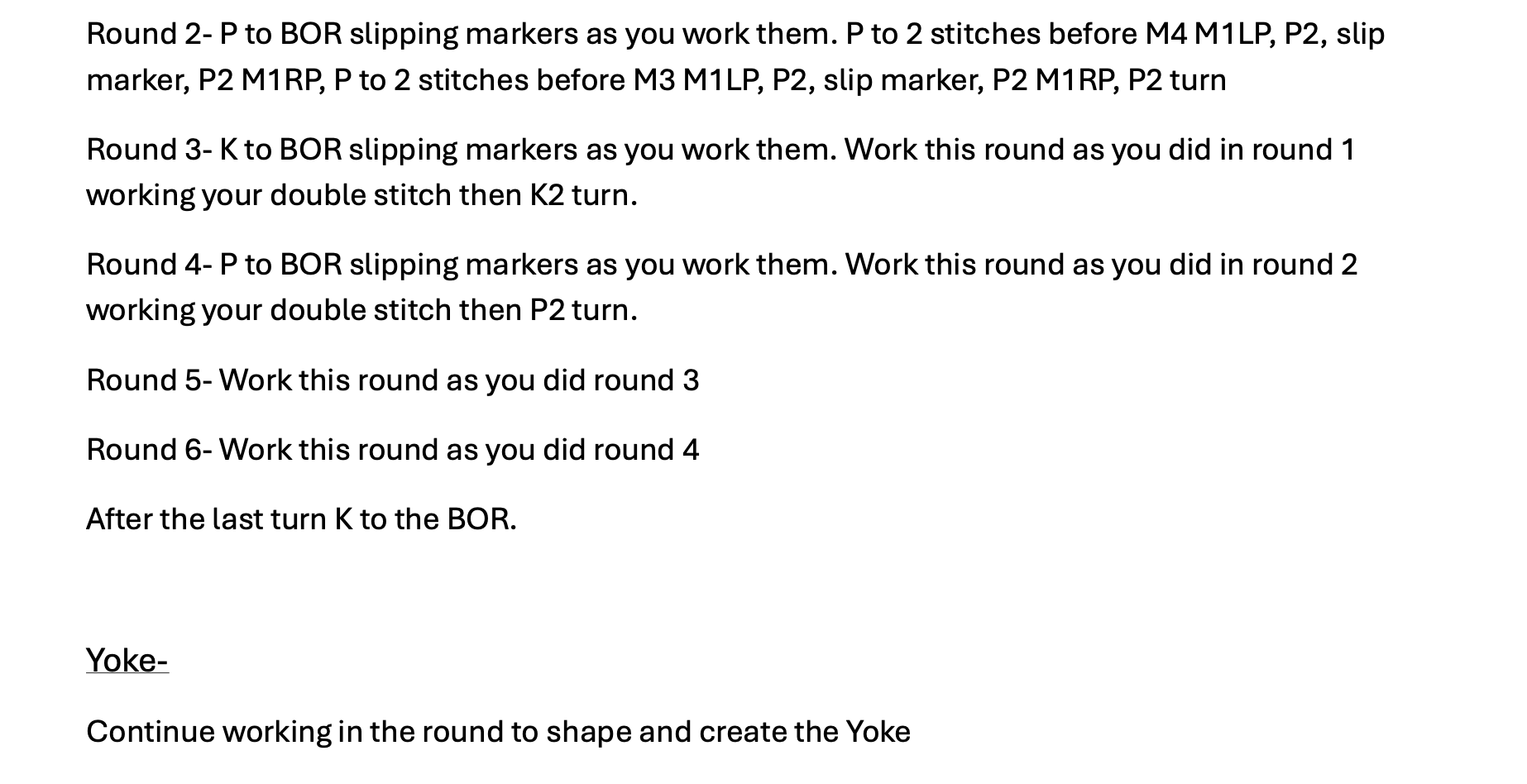
A string of numbers with random interspersed letters and something about a short row of Germans? So instead I found a different pattern for a headband with fewer numbers and letters, so I could begin to decipher this strange new language.
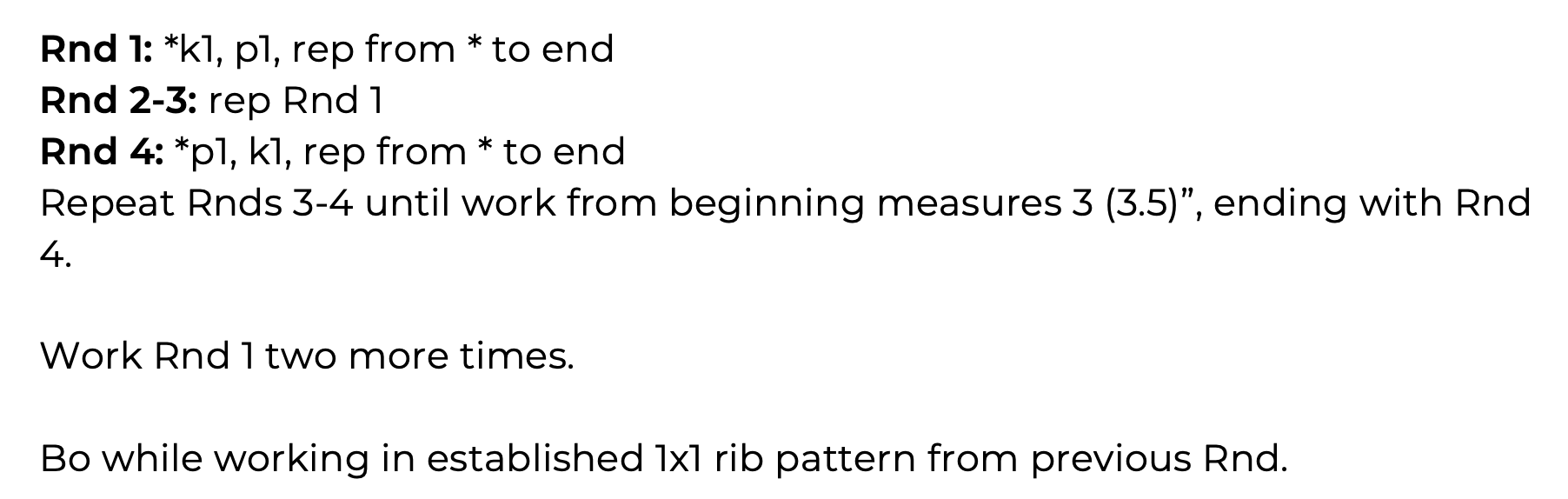
This was palatable. k stands for knit and p stands for purl and once I taught myself how to do those, I slowly began knitting this headband, unravelling a few times, until I started to understand the language and how it translated to twisting the yarn in a specific, codified way to generate a stitch. Knit stitches get the yarn to make V shapes and purl makes a small pearl-like blob. A string of stitches makes a round, and several rounds make a headband!

Soon after my first project, I started noticing how changing the order of these stitches gives your fabric different patterns - simply knit stitches next to each other give you this nested chevron texture, called a stockinette, while alternating knit and purls gave you a rib texture, like the sleeves of your sweater. In a relatively short amount of time, I managed to get to the point of actually being able to follow my sweater pattern.
And then it dawned on me.
This pattern is code.
A program, written in a universal language, that gives me the exact instructions to manipulate a ball of yarn into the exact 3D shape of a sweater. I thought I was some sort of genius to have figured this out, only to realize that the Greeks did it several hundred years ago. In fact, the word ‘textile’ and ‘technology’ literally derive from the same Proto-Indo-European word ‘tek’ which translates to ‘to weave’!
So why then, had I spent most of my life treating one as trivial and the other as transformative?
the failure of modern education
The trouble with technology is the price you pay for its efficiency. When a technology becomes scalable and widely accessible, it obfuscates the ancient knowledge behind it.
We’ve seen this before. When textile mills in Manchester, England, began weaving reams of cotton in a matter of minutes, they didn’t just put Indian handlooms out of business, they disincentivized the transfer of skill. After all, when you have access to a dozen clothes at the swipe of your thumbs, why would you ever learn the difference between knit or woven fabrics? In many ways, you’ve given up literacy. This intuitive education of how to care for natural fabrics, any why you cannot machine wash your knits3 is irrelevant in a society where it’s normal to replace your sweaters come winter season.
But I think we need to teach people these things.
This type of knowledge lived through generations of Japanese monks who preserved the art of folding paper for millennia, until one day a NASA engineer found use for this craft to design collapsible solar panels for the Mars rover.
Maybe that’s why I learned to knit. Not because it’s simple, but because it isn’t. It’s a life that lives outside this efficient, goal-oriented daze that is modern day. In the act of making something by hand - by mending a button, embroidering a tshirt, or fermenting kombucha from scratch - I am recovering a kind of knowledge I was taught to overlook.
Knowledge that isn’t archived in books, but lives in the memory of our muscles and the warmth it brings us. Like the avakkai my Paati makes every summer, or the sarees inherited by my mother, her sisters and cousins from their mothers. Each one a time capsule - capturing the rich history of the loom it came from, the hands that wove it, and the bodies that wore it.
And one day, unbeknownst to generations prior, one of those sarees was worn by a young bride on her wedding day about to embark on a new life. Six yards of silk fabric that carried the weight of the lifetimes of the women that came before her.

Who knows, my slightly asymmetrical sweater might just be the technology that weaves the fabric of our future Martian life.
From Scratch is always chaotic and always free! If you are having a good time, tell a few good friends about it. It helps me stay motivated :)
The scientific term for when a small piece of crystal causes the molecules in the solution to organize themselves around the the crystal, thereby propagating it until the whole mixture crystallizes.
Mysore pak is South India’s answer to caramel - a candied sugar and chickpea flour-based dessert.
Also can we talk about polyester “wool”. I am so paranoid of accidentally throwing my knits in the wash!


